Biochemistry Biomolecules, Enzymes, Metabolism, and Genetic Information
2.3.2 Types of Enzymes (EC Classes)
The International Union of Biochemistry classifies enzymes into seven major EC classes by reaction type: Oxidoreductases (electron transfer), Transferases (functional group transfer, including kinases), Hydrolases (cleavage using H2O), Lyases (non-hydrolytic bond cleavage/addition forming double bonds or rings), Isomerases (intramolecular rearrangement), Ligases (ATP-dependent bond formation), and Translocases (membrane transport).
Why This Matters & Core Foundation
Building directly on water, hydrogen bonding, the hydrophobic effect, and acid-base chemistry from Chapter 1, Types of Enzymes (EC Classes) explains how small chemical building blocks determine the three-dimensional shape and activity of proteins and enzymes. Any mention of a specific metabolic pathway or hormone below is just a brief real-world preview—we will study those systems in full detail in later chapters.
As you work through this lesson, focus on three connected questions: (1) what molecular structures or functional groups are involved in oxidoreductases, (2) how transferases behaves in aqueous cellular conditions, and (3) why hydrolases is essential for living cells.
Key Relationship — Types of Enzymes (EC Classes)
The International Union of Biochemistry classifies enzymes into seven major EC classes by reaction type: Oxidoreductases (electron transfer), Transferases (functional group transfer, including kinases), Hydrolases (cleavage using H2O), Lyases (non-hydrolytic bond cleavage/addition forming double bonds or rings), Isomerases (intramolecular rearrangement), Ligases (ATP-dependent bond formation), and Translocases (membrane transport).
Example 1: Classifying Enzymes into the 7 IUBMB Classes
Identify the EC class for each of the following reactions: (a) Glucose + ATP → Glucose-6-phosphate + ADP; (b) Peptide + H2O → Two shorter peptides; (c) Pyruvate + CO2 + ATP → Oxaloacetate + ADP + Pi.
Show solution
(a) EC 2 — Transferase (Kinase): Transfers a phosphoryl group from ATP to glucose.
(b) EC 3 — Hydrolase (Protease): Cleaves a covalent peptide bond by adding water.
(c) EC 6 — Ligase (Carboxylase): Joins two molecules (pyruvate and \(\text{CO}_2\)) coupled to ATP hydrolysis.
IUBMB Classification Table — The 7 Classes of Enzymes
The International Union of Biochemistry and Molecular Biology (IUBMB) classifies every enzyme into one of seven major Enzyme Commission (EC) classes based on the overall chemical transformation it catalyzes. The table below summarizes the seven classes, followed by each class's generalized reaction formula and catalytic mechanism.
EC Class
Enzyme Class
Reaction Type Catalyzed
Typical Cofactors
Representative Examples
EC 1
Oxidoreductases
Oxidation–reduction (electron / hydride transfer)
NAD+/NADP+, FAD/FMN, Heme, Fe-S clusters
Lactate dehydrogenase, Succinate dehydrogenase, Cytochrome c oxidase
EC 2
Transferases
Transfer of a functional group (phosphoryl, acyl, amino, methyl)
Generalized Reaction Formulas & Catalytic Mechanisms by Enzyme Class
Understanding how each enzyme class lowers the transition-state activation barrier (\(\Delta G^\ddagger\)) makes it straightforward to predict substrates, cofactors, and reaction mechanisms across every metabolic pathway.
How They Catalyze the Reaction: Oxidoreductases catalyze electron transfer between a donor (reductant) and an acceptor (oxidant), most often as a direct hydride ion (H:⁻) transfer to the nicotinamide ring of NAD+/NADP+ or as two-step 1-electron/2-electron transfers via flavins (FAD/FMN) and transition-metal centers (Fe, Cu). In dehydrogenases (e.g., lactate dehydrogenase), an active-site histidine abstracts a proton from the alcohol -OH while C-H hydride attacks C4 of NAD+, converting lactate to pyruvate + NADH.
Key Subclasses: Dehydrogenases (transfer H- to NAD+/FAD), Oxidases (use O2 as e- acceptor without incorporating O), Oxygenases (incorporate O from O2 into substrate), Peroxidases/Catalases (reduce H2O2).
How They Catalyze the Reaction: Transferases move an intact chemical group X from a donor molecule A–X to an acceptor B via either a sequential ternary complex (direct in-line nucleophilic attack, as in hexokinase where glucose C6-OH attacks the γ-phosphorus of Mg2+·ATP through a pentacoordinate transition state) or a double-displacement "ping-pong" mechanism (as in PLP-dependent aminotransferases, where the amino group is temporarily stored on pyridoxamine phosphate before transfer to an α-ketoacid).
Key Subclasses: Kinases (transfer PO3^2- from ATP to substrate), Aminotransferases/Transaminases (transfer -NH2 via PLP), Acyltransferases (transfer acyl groups from CoA), Methyltransferases (transfer -CH3 from SAM), Glycosyltransferases.
How They Catalyze the Reaction: Hydrolases cleave covalent bonds by adding the elements of water (H+ and OH-) across the bond. Because water is a weak nucleophile on its own, hydrolases either activate water directly via a general base or Lewis-acid metal ion (Zn2+ in carboxypeptidase A) or operate via two-step covalent catalysis (such as the Asp-His-Ser catalytic triad in chymotrypsin: Ser attacks the peptide carbonyl to form an acyl-enzyme intermediate, and His then activates H2O to hydrolyze the acyl-enzyme).
How They Catalyze the Reaction: Lyases break C–C, C–O, or C–N bonds by elimination—generating a new double bond or ring—without using water (unlike hydrolases) and without net redox (unlike oxidoreductases); in the reverse direction they add a group across a double bond. Class I aldolase uses an active-site lysine to form a protonated Schiff-base (iminium) electron sink with fructose-1,6-bisphosphate, stabilizing the carbanion during C3–C4 cleavage into DHAP and GAP.
Key Subclasses: Decarboxylases (remove CO2), Aldolases (reverse aldol C–C cleavage), Dehydratases/Hydratases (remove/add H2O to form/saturate a C=C double bond), Synthases (condense two substrates WITHOUT nucleoside triphosphate hydrolysis).
How They Catalyze the Reaction: Isomerases rearrange atoms within a single substrate molecule so the reactant and product have identical molecular formulas. For example, triose phosphate isomerase (TPI) uses an active-site glutamate (general base) and histidine (general acid) to interconvert DHAP and GAP through a planar cis-enediolate intermediate, while phosphoglycerate mutase transfers a phosphoryl group from a phosphorylated histidine to 3-PG to form a 2,3-BPG intermediate before removing the C3 phosphate.
Key Subclasses: Racemases & Epimerases (invert a chiral center), Cis-Trans Isomerases (rotate around a double/peptide bond), Intramolecular Oxidoreductases (aldose ⇌ ketose), Mutases (shift a functional group such as -PO3^2- to another atom within the same molecule).
How They Catalyze the Reaction: Joining two separate molecules into a new covalent bond is typically endergonic (ΔG > 0). Ligases overcome this barrier by coupling bond formation to the exergonic hydrolysis of ATP (or GTP/NAD+) via an activated high-energy intermediate—most commonly an acyl-phosphate (e.g., γ-glutamyl phosphate in glutamine synthetase) or an acyl-adenylate / enzyme-AMP intermediate (e.g., aminoacyl-tRNA synthetases and DNA ligase). Subsequent pyrophosphatase cleavage of PPi makes the ligation irreversible.
Key Subclasses: Synthetases (form C–N, C–O, or C–S bonds coupled to ATP cleavage—note the distinction from ATP-independent EC 4 synthases), Carboxylases (biotin-dependent ATP-driven CO2 fixation), DNA/RNA Ligases (form phosphodiester bonds).
How They Catalyze the Reaction: Added by the IUBMB in 2018 as the seventh official EC class, translocases couple a chemical reaction (ATP hydrolysis, redox electron flow, or decarboxylation) to directional transmembrane transport via an alternating-access conformational cycle (E1 ⇌ E2). For example, the Na+/K+-ATPase binds 3 intracellular Na+ in the E1 state, autophosphorylates a conserved Asp residue using ATP, flips to the E2-P outward-facing state to release 3 Na+ and bind 2 extracellular K+, and dephosphorylates to return to E1.
Example 2: Distinguishing a Lyase (Synthase) from a Ligase (Synthetase) and Hydrolase
Fumarase adds water across the double bond of fumarate to form malate, whereas trypsin uses water to cleave a peptide bond. Why is fumarase classified as a lyase (EC 4) while trypsin is a hydrolase (EC 3)?
Show solution
Hydrolases (EC 3) use water to break a single bond into two separate molecules (\(\text{A}-\text{B} + \text{H}_2\text{O} \to \text{A}-\text{OH} + \text{H}-\text{B}\)).
Lyases (EC 4) add or eliminate small groups (like \(\text{H}_2\text{O}\) or \(\text{CO}_2\)) across a double bond without splitting the carbon skeleton into two separate products. Similarly, remember the key naming distinction: synthetases (EC 6) require ATP/NTP hydrolysis, whereas synthases (EC 4) do not.
Visualizing Structures & Mechanisms
Chemistry is visual—use the template diagrams below to map out key functional groups, stereochemistry, and step-by-step molecular changes in types of enzymes (ec classes).
Figure A — Structure & Functional Groups: Oxidoreductases
Template space for 2D chemical structures and key functional groups in types of enzymes (ec classes).
/public/images/biochemistry/2.3.2-types-of-enzymes-structure.svgFigure B — Mechanism Overview: Types of Enzymes (EC Classes)
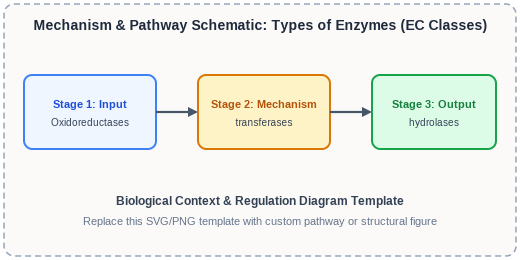
Template space for illustrating how oxidoreductases connects to transferases.
/public/images/biochemistry/2.3.2-types-of-enzymes-mechanism.svg
Central Principle: The International Union of Biochemistry classifies enzymes into seven major EC classes by reaction type: Oxidoreductases (electron transfer), Transferases (functional group transfer, including kinases), Hydrolases (cleavage using H2O), Lyases (non-hydrolytic bond cleavage/addition forming double bonds or rings), Isomerases (intramolecular rearrangement), Ligases (ATP-dependent bond formation), and Translocases (membrane transport).
Explore Further: Use the Practice Problems tab at the top of the page to test yourself with 15 practice questions, or open the Interactive Biochemistry Subway Map to see how biochemical pathways connect.