8.1.5 DNA Damage & Repair
Cells maintain genomic integrity through specialized repair pathways: (1) Mismatch Repair (MMR; MutS/MutL or MSH2/MLH1; defective in Lynch syndrome) corrects replication errors on the newly synthesized strand; (2) Base Excision Repair (BER) removes small single-base lesions (uracil from cytosine deamination, 8-oxoguanine) via DNA glycosylase → AP site → AP endonuclease → Pol β → ligase; (3) Nucleotide Excision Repair (NER; defective in Xeroderma Pigmentosum) excises bulky helix-distorting lesions such as UV-induced cyclobutane pyrimidine (thymine) dimers as an oligonucleotide patch; and (4) Double-strand breaks are repaired error-free in S/G2 by Homologous Recombination (BRCA1/2, Rad51) or error-prone in G1 by Non-Homologous End Joining (NHEJ).
Why This Matters & Core Foundation
Building on nucleic acid structure (Chapter 6) and enzyme catalysis (Chapter 2), DNA Damage & Repair explains how cells copy, repair, transcribe, and translate genetic information—and how biochemists analyze these molecules in the laboratory.
As you work through this lesson, focus on three connected questions: (1) what molecular structures or functional groups are involved in point and frameshift mutations, (2) how mismatch repair behaves in aqueous cellular conditions, and (3) why base excision repair (ber) is essential for living cells.
Key Relationship — DNA Damage & Repair
Cells maintain genomic integrity through specialized repair pathways: (1) Mismatch Repair (MMR; MutS/MutL or MSH2/MLH1; defective in Lynch syndrome) corrects replication errors on the newly synthesized strand; (2) Base Excision Repair (BER) removes small single-base lesions (uracil from cytosine deamination, 8-oxoguanine) via DNA glycosylase → AP site → AP endonuclease → Pol β → ligase; (3) Nucleotide Excision Repair (NER; defective in Xeroderma Pigmentosum) excises bulky helix-distorting lesions such as UV-induced cyclobutane pyrimidine (thymine) dimers as an oligonucleotide patch; and (4) Double-strand breaks are repaired error-free in S/G2 by Homologous Recombination (BRCA1/2, Rad51) or error-prone in G1 by Non-Homologous End Joining (NHEJ).
Example 1: Applying the Core Principle of DNA Damage & Repair
A biochemistry student is reviewing dna damage & repair. Explain how point and frameshift mutations works at physiological pH 7.4 and how it connects to the governing relationship for this topic.
Show solution
Start from the governing relationship for DNA Damage & Repair:
Cells maintain genomic integrity through specialized repair pathways: (1) Mismatch Repair (MMR; MutS/MutL or MSH2/MLH1; defective in Lynch syndrome) corrects replication errors on the newly synthesized strand; (2) Base Excision Repair (BER) removes small single-base lesions (uracil from cytosine deamination, 8-oxoguanine) via DNA glycosylase → AP site → AP endonuclease → Pol β → ligase; (3) Nucleotide Excision Repair (NER; defective in Xeroderma Pigmentosum) excises bulky helix-distorting lesions such as UV-induced cyclobutane pyrimidine (thymine) dimers as an oligonucleotide patch; and (4) Double-strand breaks are repaired error-free in S/G2 by Homologous Recombination (BRCA1/2, Rad51) or error-prone in G1 by Non-Homologous End Joining (NHEJ).
Visualizing Structures & Mechanisms
Chemistry is visual—use the template diagrams below to map out key functional groups, stereochemistry, and step-by-step molecular changes in dna damage & repair.
/public/images/biochemistry/8.1.5-damage-and-repair-structure.svg
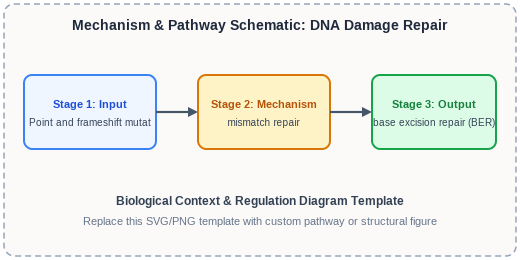
/public/images/biochemistry/8.1.5-damage-and-repair-mechanism.svg
Core Topics in DNA Damage & Repair
- Point and frameshift mutations: Examine how this chemical feature contributes to dna damage & repair and connects directly to the governing relationship above.
- Mismatch repair: Examine how this chemical feature contributes to dna damage & repair and connects directly to the governing relationship above.
- Base excision repair (BER): Examine how this chemical feature contributes to dna damage & repair and connects directly to the governing relationship above.
- Nucleotide excision repair (NER): Examine how this chemical feature contributes to dna damage & repair and connects directly to the governing relationship above.
- NHEJ and HR: Examine how this chemical feature contributes to dna damage & repair and connects directly to the governing relationship above.
Key Takeaways
- Core Topics: Point and frameshift mutations, mismatch repair, base excision repair (BER), nucleotide excision repair (NER), NHEJ and HR.
- Central Principle: Cells maintain genomic integrity through specialized repair pathways: (1) Mismatch Repair (MMR; MutS/MutL or MSH2/MLH1; defective in Lynch syndrome) corrects replication errors on the newly synthesized strand; (2) Base Excision Repair (BER) removes small single-base lesions (uracil from cytosine deamination, 8-oxoguanine) via DNA glycosylase → AP site → AP endonuclease → Pol β → ligase; (3) Nucleotide Excision Repair (NER; defective in Xeroderma Pigmentosum) excises bulky helix-distorting lesions such as UV-induced cyclobutane pyrimidine (thymine) dimers as an oligonucleotide patch; and (4) Double-strand breaks are repaired error-free in S/G2 by Homologous Recombination (BRCA1/2, Rad51) or error-prone in G1 by Non-Homologous End Joining (NHEJ).
- Explore Further: Use the Practice Problems tab at the top of the page to test yourself with 15 practice questions, or open the Interactive Biochemistry Subway Map to see how biochemical pathways connect.