8.5.2 Electrophoresis, Blotting & Assays
Analytical techniques resolve and quantify biomolecules: Native PAGE separates intact folded proteins by charge-to-size ratio; SDS-PAGE coats proteins with the anionic detergent sodium dodecyl sulfate (imparting a uniform negative charge-to-mass ratio) so migration depends solely on molecular weight (with β-mercaptoethanol or DTT reducing disulfide bonds); Isoelectric Focusing (IEF) moves proteins across a pH gradient until pH = pI (combined with SDS-PAGE in 2D electrophoresis). Blotting methods detect DNA (Southern), RNA (Northern), or protein (Western, using primary/secondary antibodies), while ELISA quantifies antigens/antibodies, PCR amplifies DNA exponentially (2^n copies across n thermal cycles using Taq polymerase), and X-ray crystallography, NMR, and Cryo-EM determine atomic 3D structures.
Why This Matters & Core Foundation
Building on nucleic acid structure (Chapter 6) and enzyme catalysis (Chapter 2), Electrophoresis, Blotting & Assays explains how cells copy, repair, transcribe, and translate genetic information—and how biochemists analyze these molecules in the laboratory.
As you work through this lesson, focus on three connected questions: (1) what molecular structures or functional groups are involved in native page, (2) how sds-page behaves in aqueous cellular conditions, and (3) why isoelectric focusing is essential for living cells.
Key Relationship — Electrophoresis, Blotting & Assays
Analytical techniques resolve and quantify biomolecules: Native PAGE separates intact folded proteins by charge-to-size ratio; SDS-PAGE coats proteins with the anionic detergent sodium dodecyl sulfate (imparting a uniform negative charge-to-mass ratio) so migration depends solely on molecular weight (with β-mercaptoethanol or DTT reducing disulfide bonds); Isoelectric Focusing (IEF) moves proteins across a pH gradient until pH = pI (combined with SDS-PAGE in 2D electrophoresis). Blotting methods detect DNA (Southern), RNA (Northern), or protein (Western, using primary/secondary antibodies), while ELISA quantifies antigens/antibodies, PCR amplifies DNA exponentially (2^n copies across n thermal cycles using Taq polymerase), and X-ray crystallography, NMR, and Cryo-EM determine atomic 3D structures.
Example 1: Applying the Core Principle of Electrophoresis, Blotting & Assays
A biochemistry student is reviewing electrophoresis, blotting & assays. Explain how native page works at physiological pH 7.4 and how it connects to the governing relationship for this topic.
Show solution
Start from the governing relationship for Electrophoresis, Blotting & Assays:
Analytical techniques resolve and quantify biomolecules: Native PAGE separates intact folded proteins by charge-to-size ratio; SDS-PAGE coats proteins with the anionic detergent sodium dodecyl sulfate (imparting a uniform negative charge-to-mass ratio) so migration depends solely on molecular weight (with β-mercaptoethanol or DTT reducing disulfide bonds); Isoelectric Focusing (IEF) moves proteins across a pH gradient until pH = pI (combined with SDS-PAGE in 2D electrophoresis). Blotting methods detect DNA (Southern), RNA (Northern), or protein (Western, using primary/secondary antibodies), while ELISA quantifies antigens/antibodies, PCR amplifies DNA exponentially (2^n copies across n thermal cycles using Taq polymerase), and X-ray crystallography, NMR, and Cryo-EM determine atomic 3D structures.
Visualizing Structures & Mechanisms
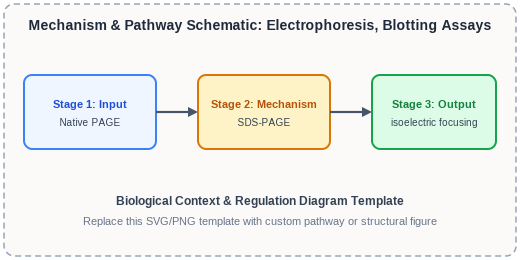
Chemistry is visual—use the template diagrams below to map out key functional groups, stereochemistry, and step-by-step molecular changes in electrophoresis, blotting & assays.
/public/images/biochemistry/8.5.2-electrophoresis-and-assays-structure.svg
/public/images/biochemistry/8.5.2-electrophoresis-and-assays-mechanism.svg
Core Topics in Electrophoresis, Blotting & Assays
- Native PAGE: Examine how this chemical feature contributes to electrophoresis, blotting & assays and connects directly to the governing relationship above.
- SDS-PAGE: Examine how this chemical feature contributes to electrophoresis, blotting & assays and connects directly to the governing relationship above.
- Isoelectric focusing: Examine how this chemical feature contributes to electrophoresis, blotting & assays and connects directly to the governing relationship above.
- 2D-PAGE: Examine how this chemical feature contributes to electrophoresis, blotting & assays and connects directly to the governing relationship above.
- Western/Southern/Northern blots: Examine how this chemical feature contributes to electrophoresis, blotting & assays and connects directly to the governing relationship above.
- ELISA: Examine how this chemical feature contributes to electrophoresis, blotting & assays and connects directly to the governing relationship above.
- PCR: Examine how this chemical feature contributes to electrophoresis, blotting & assays and connects directly to the governing relationship above.
- X-ray/NMR/Cryo-EM: Examine how this chemical feature contributes to electrophoresis, blotting & assays and connects directly to the governing relationship above.
Key Takeaways
- Core Topics: Native PAGE, SDS-PAGE, isoelectric focusing, 2D-PAGE, Western/Southern/Northern blots, ELISA, PCR, X-ray/NMR/Cryo-EM.
- Central Principle: Analytical techniques resolve and quantify biomolecules: Native PAGE separates intact folded proteins by charge-to-size ratio; SDS-PAGE coats proteins with the anionic detergent sodium dodecyl sulfate (imparting a uniform negative charge-to-mass ratio) so migration depends solely on molecular weight (with β-mercaptoethanol or DTT reducing disulfide bonds); Isoelectric Focusing (IEF) moves proteins across a pH gradient until pH = pI (combined with SDS-PAGE in 2D electrophoresis). Blotting methods detect DNA (Southern), RNA (Northern), or protein (Western, using primary/secondary antibodies), while ELISA quantifies antigens/antibodies, PCR amplifies DNA exponentially (2^n copies across n thermal cycles using Taq polymerase), and X-ray crystallography, NMR, and Cryo-EM determine atomic 3D structures.
- Explore Further: Use the Practice Problems tab at the top of the page to test yourself with 15 practice questions, or open the Interactive Biochemistry Subway Map to see how biochemical pathways connect.