7.4.5 Cholesterol Synthesis
All 27 carbons of cholesterol are derived from cytosolic acetyl-CoA in a four-stage pathway: (1) Three acetyl-CoA condense to form 3-hydroxy-3-methylglutaryl-CoA (HMG-CoA), which is reduced to 6C mevalonate by the rate-limiting ER enzyme HMG-CoA Reductase (competitively inhibited by statin drugs, transcriptionally induced by SREBP-2 at low sterols, and inactivated by AMPK phosphorylation); (2) Mevalonate is phosphorylated and decarboxylated to 5C activated isoprene units (IPP and DMAPP); (3) Six isoprenes condense via farnesyl pyrophosphate (15C) into linear 30C squalene; (4) Squalene cyclizes via lanosterol into 27C cholesterol (precursor to bile acids, steroid hormones, and Vitamin D).
Why This Matters & Core Foundation
Bringing together thermodynamics (Chapter 1), enzymes and cofactors (Chapter 2), membranes (Chapter 3), signaling (Chapter 4), and carbohydrates (Chapter 5), Cholesterol Synthesis traces how cells harvest energy and synthesize essential biomolecules in coordinated pathways.
As you work through this lesson, focus on three connected questions: (1) what molecular structures or functional groups are involved in mevalonate pathway, (2) how hmg-coa reductase (rate-limiting target of statins) behaves in aqueous cellular conditions, and (3) why isoprenoids is essential for living cells.
Key Relationship — Cholesterol Synthesis
All 27 carbons of cholesterol are derived from cytosolic acetyl-CoA in a four-stage pathway: (1) Three acetyl-CoA condense to form 3-hydroxy-3-methylglutaryl-CoA (HMG-CoA), which is reduced to 6C mevalonate by the rate-limiting ER enzyme HMG-CoA Reductase (competitively inhibited by statin drugs, transcriptionally induced by SREBP-2 at low sterols, and inactivated by AMPK phosphorylation); (2) Mevalonate is phosphorylated and decarboxylated to 5C activated isoprene units (IPP and DMAPP); (3) Six isoprenes condense via farnesyl pyrophosphate (15C) into linear 30C squalene; (4) Squalene cyclizes via lanosterol into 27C cholesterol (precursor to bile acids, steroid hormones, and Vitamin D).
Example 1: Applying the Core Principle of Cholesterol Synthesis
A biochemistry student is reviewing cholesterol synthesis. Explain how mevalonate pathway works at physiological pH 7.4 and how it connects to the governing relationship for this topic.
Show solution
Start from the governing relationship for Cholesterol Synthesis:
All 27 carbons of cholesterol are derived from cytosolic acetyl-CoA in a four-stage pathway: (1) Three acetyl-CoA condense to form 3-hydroxy-3-methylglutaryl-CoA (HMG-CoA), which is reduced to 6C mevalonate by the rate-limiting ER enzyme HMG-CoA Reductase (competitively inhibited by statin drugs, transcriptionally induced by SREBP-2 at low sterols, and inactivated by AMPK phosphorylation); (2) Mevalonate is phosphorylated and decarboxylated to 5C activated isoprene units (IPP and DMAPP); (3) Six isoprenes condense via farnesyl pyrophosphate (15C) into linear 30C squalene; (4) Squalene cyclizes via lanosterol into 27C cholesterol (precursor to bile acids, steroid hormones, and Vitamin D).
Visualizing Structures & Mechanisms
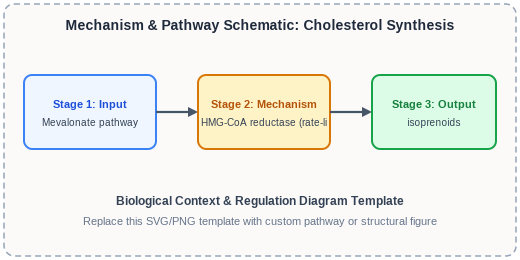
Chemistry is visual—use the template diagrams below to map out key functional groups, stereochemistry, and step-by-step molecular changes in cholesterol synthesis.
/public/images/biochemistry/7.4.5-cholesterol-synthesis-structure.svg
/public/images/biochemistry/7.4.5-cholesterol-synthesis-mechanism.svg
Core Topics in Cholesterol Synthesis
- Mevalonate pathway: Examine how this chemical feature contributes to cholesterol synthesis and connects directly to the governing relationship above.
- HMG-CoA reductase (rate-limiting target of statins): Examine how this chemical feature contributes to cholesterol synthesis and connects directly to the governing relationship above.
- Isoprenoids: Examine how this chemical feature contributes to cholesterol synthesis and connects directly to the governing relationship above.
- Squalene: Examine how this chemical feature contributes to cholesterol synthesis and connects directly to the governing relationship above.
- Bile acids and steroid hormones: Examine how this chemical feature contributes to cholesterol synthesis and connects directly to the governing relationship above.
Key Takeaways
- Core Topics: Mevalonate pathway, HMG-CoA reductase (rate-limiting target of statins), isoprenoids, squalene, bile acids and steroid hormones.
- Central Principle: All 27 carbons of cholesterol are derived from cytosolic acetyl-CoA in a four-stage pathway: (1) Three acetyl-CoA condense to form 3-hydroxy-3-methylglutaryl-CoA (HMG-CoA), which is reduced to 6C mevalonate by the rate-limiting ER enzyme HMG-CoA Reductase (competitively inhibited by statin drugs, transcriptionally induced by SREBP-2 at low sterols, and inactivated by AMPK phosphorylation); (2) Mevalonate is phosphorylated and decarboxylated to 5C activated isoprene units (IPP and DMAPP); (3) Six isoprenes condense via farnesyl pyrophosphate (15C) into linear 30C squalene; (4) Squalene cyclizes via lanosterol into 27C cholesterol (precursor to bile acids, steroid hormones, and Vitamin D).
- Explore Further: Use the Practice Problems tab at the top of the page to test yourself with 15 practice questions, or open the Interactive Biochemistry Subway Map to see how biochemical pathways connect.