8.1.3 Chromatin Structure & Packaging
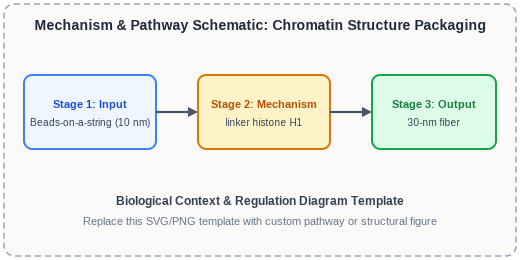
Eukaryotic nuclear DNA (~2 meters per human diploid cell) is compacted ~10,000-fold into chromatin. The fundamental repeating unit is the 10-nm "beads-on-a-string" nucleosome core particle (147 bp wrapped around an H2A2H2B2H32H42 octamer) separated by ~20–50 bp of linker DNA bound by linker histone H1, which promotes folding into condensed 30-nm fibers and looped domains anchored to nuclear scaffold proteins. Transcriptionally active, loosely packed chromatin is called euchromatin, while densely compacted, transcriptionally silent chromatin is called heterochromatin.
Why This Matters & Core Foundation
Building on nucleic acid structure (Chapter 6) and enzyme catalysis (Chapter 2), Chromatin Structure & Packaging explains how cells copy, repair, transcribe, and translate genetic information—and how biochemists analyze these molecules in the laboratory.
As you work through this lesson, focus on three connected questions: (1) what molecular structures or functional groups are involved in beads-on-a-string (10 nm), (2) how linker histone h1 behaves in aqueous cellular conditions, and (3) why 30-nm fiber is essential for living cells.
Key Relationship — Chromatin Structure & Packaging
Eukaryotic nuclear DNA (~2 meters per human diploid cell) is compacted ~10,000-fold into chromatin. The fundamental repeating unit is the 10-nm "beads-on-a-string" nucleosome core particle (147 bp wrapped around an H2A2H2B2H32H42 octamer) separated by ~20–50 bp of linker DNA bound by linker histone H1, which promotes folding into condensed 30-nm fibers and looped domains anchored to nuclear scaffold proteins. Transcriptionally active, loosely packed chromatin is called euchromatin, while densely compacted, transcriptionally silent chromatin is called heterochromatin.
Example 1: Applying the Core Principle of Chromatin Structure & Packaging
A biochemistry student is reviewing chromatin structure & packaging. Explain how beads-on-a-string (10 nm) works at physiological pH 7.4 and how it connects to the governing relationship for this topic.
Show solution
Start from the governing relationship for Chromatin Structure & Packaging:
Eukaryotic nuclear DNA (~2 meters per human diploid cell) is compacted ~10,000-fold into chromatin. The fundamental repeating unit is the 10-nm "beads-on-a-string" nucleosome core particle (147 bp wrapped around an H2A2H2B2H32H42 octamer) separated by ~20–50 bp of linker DNA bound by linker histone H1, which promotes folding into condensed 30-nm fibers and looped domains anchored to nuclear scaffold proteins. Transcriptionally active, loosely packed chromatin is called euchromatin, while densely compacted, transcriptionally silent chromatin is called heterochromatin.
Visualizing Structures & Mechanisms
Chemistry is visual—use the template diagrams below to map out key functional groups, stereochemistry, and step-by-step molecular changes in chromatin structure & packaging.
/public/images/biochemistry/8.1.3-chromatin-structure-and-packaging-structure.svg
/public/images/biochemistry/8.1.3-chromatin-structure-and-packaging-mechanism.svg
Core Topics in Chromatin Structure & Packaging
- Beads-on-a-string (10 nm): Examine how this chemical feature contributes to chromatin structure & packaging and connects directly to the governing relationship above.
- Linker histone H1: Examine how this chemical feature contributes to chromatin structure & packaging and connects directly to the governing relationship above.
- 30-nm fiber: Examine how this chemical feature contributes to chromatin structure & packaging and connects directly to the governing relationship above.
- Euchromatin vs. heterochromatin: Examine how this chemical feature contributes to chromatin structure & packaging and connects directly to the governing relationship above.
Key Takeaways
- Core Topics: Beads-on-a-string (10 nm), linker histone H1, 30-nm fiber, euchromatin vs. heterochromatin.
- Central Principle: Eukaryotic nuclear DNA (~2 meters per human diploid cell) is compacted ~10,000-fold into chromatin. The fundamental repeating unit is the 10-nm "beads-on-a-string" nucleosome core particle (147 bp wrapped around an H2A2H2B2H32H42 octamer) separated by ~20–50 bp of linker DNA bound by linker histone H1, which promotes folding into condensed 30-nm fibers and looped domains anchored to nuclear scaffold proteins. Transcriptionally active, loosely packed chromatin is called euchromatin, while densely compacted, transcriptionally silent chromatin is called heterochromatin.
- Explore Further: Use the Practice Problems tab at the top of the page to test yourself with 15 practice questions, or open the Interactive Biochemistry Subway Map to see how biochemical pathways connect.